
Cuba’s systemic crisis
What might come next for U.S.-Cuba relations?
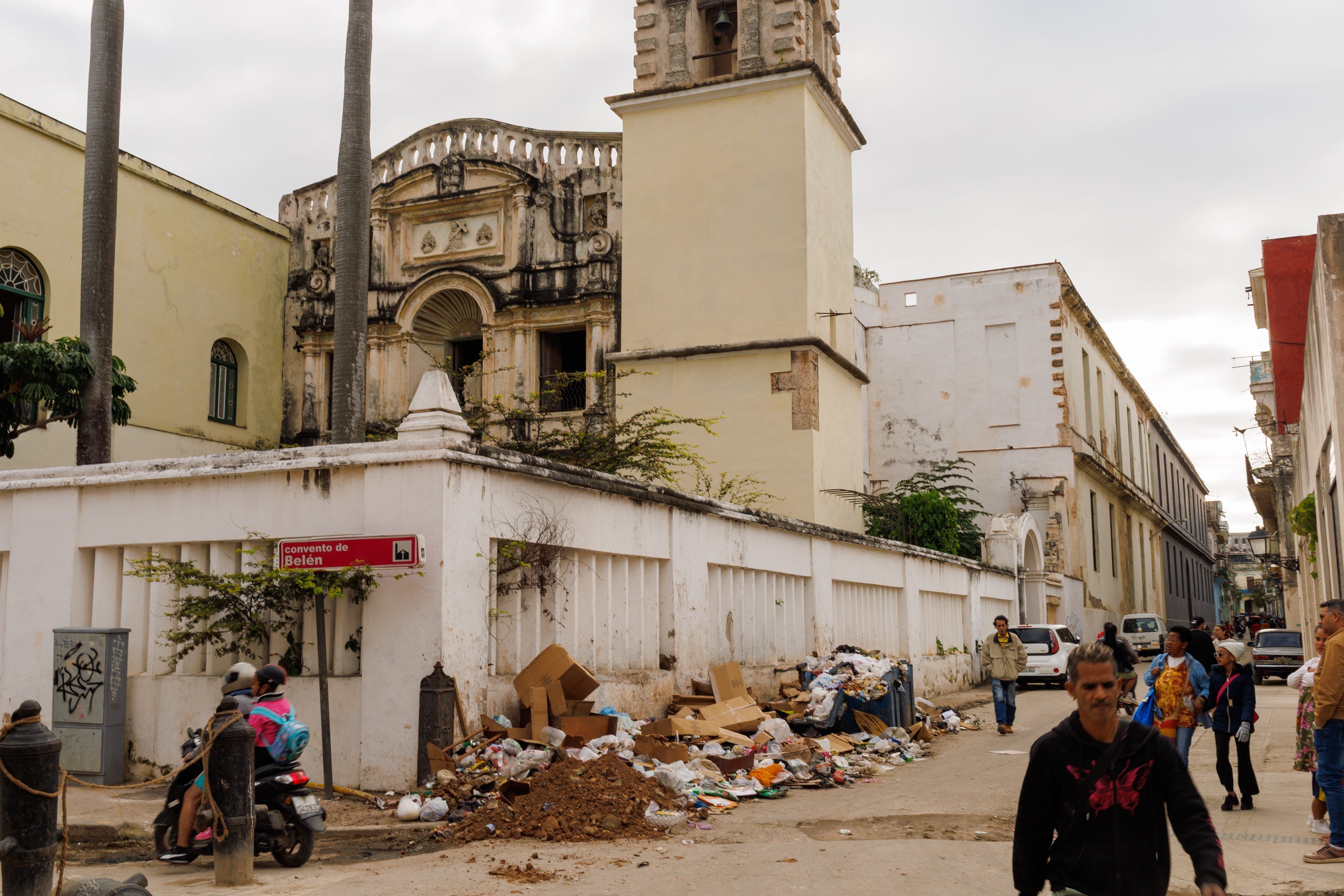
Garbage piled up on the streets of Centro Havana (ProSportFoto-Tony Lewis)
By Cristina Lopez-Gottardi Chao
Over the last few weeks, tensions both domestically in Cuba and in its relations with the United States have intensified significantly. What had previously been a slow-burning crisis defined by empty store shelves, recurrent power outages, and deteriorating public services is now unfolding visibly in the streets.
Since early March, nightly protests have emerged across the island as frustration over food shortages, economic stagnation, chronic electricity disruptions, and restrictions on civil liberties appears to be reaching a breaking point. In the town of Morón, demonstrators reportedly entered a local Communist Party office and set fire to confiscated items. Elsewhere, citizens banged pots in protest of worsening living conditions, and students at the University of Havana staged a peaceful sit-in. Additionally, the prominent Havana journalist Yoani Sanchez reported being confined to her home by state security officials. Together, these are extraordinary acts of resistance in a system defined by its intolerance of dissent.
The situation compounded further when Cuba’s national electrical grid fully collapsed for a third time this month, plunging the island into darkness. Days later, some areas remain without power, heightening an already dire humanitarian situation. For most Cubans, the message is no longer ambiguous: The current trajectory is unsustainable.
Against this backdrop, harsh rhetoric between Washington and Havana has escalated. While both sides have acknowledged talks are underway, last week Cuban President Miguel Díaz-Canel warned that any U.S. attempt to “take control” of Cuba would be met with “impregnable resistance.” This was a response to vague statements from President Donald Trump about “freeing” or “taking” Cuba.
Yet beyond the propaganda and politics, the underlying reality is clear: Cuba’s crisis is systemic and meaningful change is both urgent and necessary.
At the center of Cuba’s financial problem lies a centrally planned socialist economy dominated by the military conglomerate GAESA (Grupo de Administración Empresarial S.A.), whose control over key sectors has entrenched systemic inefficiencies, opacity, and corruption. Nowhere is this more evident than in the country’s deepening energy crisis, which reflects not only recent external shocks but decades of underinvestment, mismanagement, and institutional rigidity.
The broader economy tells a similar story. The once-dominant sugar industry collapsed long ago for similar reasons, including mismanagement and the loss of Soviet support. Tourism, more recently a critical lifeline, has yet to recover from pre-pandemic levels. Meanwhile, the decline of subsidized oil shipments from Venezuela has fully exposed the island’s structural vulnerabilities, accelerating both the fiscal and energy crisis. Taken together, these trends underscore a central reality that the Cuban economic model has simply never been capable of sustaining itself without external support.
What, then, comes next?
Thus far, two potential pathways for change have emerged: one originating in Havana and the other Washington. But neither appears promising without significant additional changes from Cuba. Reports indicate that the Trump Administration favors the removal of President Díaz-Canel as a precondition for deeper engagement. While any leadership change would be a step in the right direction, such a move by itself risks misunderstanding how power operates in Cuba.
Unlike Nicolás Maduro in Venezuela, Díaz-Canel is not widely regarded as a central power broker. Rather, real authority remains embedded within the enduring networks tied to Raul Castro, now 94, and the military-economic elite surrounding him, which continue to exert decisive influence over the state’s core institutions. A part of that elite circle is Raul Guillermo Rodriguez Castro, grandson of the elder Castro, who is believed to be participating in conversations with U.S. Secretary of State Marco Rubio and is now making more frequent public appearances.
Replacing Díaz-Canel, therefore, may carry symbolic weight, but it would not address the root causes of Cuba’s crisis—a fact Rubio no doubt is acutely aware of. Díaz-Canel presides as the public face of a deeply entrenched system that has formally declared the socialist model “irrevocable” and whose underlying structures have remained largely intact for nearly seven decades, outlasting 13 U.S. presidents. By comparison, Venezuela’s experiment has been both shorter (roughly 26 years) and more personalized. In Cuba, power is both entrenched in the Castro brothers’ legacy and also successfully diffused amongst a small circle, institutionalized and resilient. Absent the fundamental transformation of the island’s political and economic framework, removing a single figure would do little more than transfer stewardship of the same unsustainable model.
Cuba’s proposal offers even less reassurance. Recent statements by Cuba’s Minister for Foreign Trade and Investment, Oscar Perez Olivia-Fraga, suggest openness to investments by U.S. companies and, in particular, the Cuban diaspora. On its face, this may seem to signal a degree of pragmatism. In practice, however, it amounts to little more than a rhetorical gesture and is unlikely to gain traction without meaningful reforms to strengthen the rule of law, protect property rights, ensure transparency, and address human rights concerns.
For many Cuban exiles, the proposal also carries an additional layer of political and historical sensitivity. It effectively asks individuals and families, many of whom lost homes, businesses, and assets through uncompensated expropriations following the Cuban Revolution, to reinvest under the authority of the same state structures, without any guarantees of legal protection or restitution. At best, this reflects a profound misreading of the political and historical grievances that continue to shape exile attitudes towards the Cuban state.
Even then, significant obstacles remain. The U.S. embargo, codified into law during the Clinton Administration, cannot be fully lifted without congressional action. At the same time, the central role of GAESA in managing foreign investment presents a major deterrent given that any inflow of capital would therefore require partnering, directly or indirectly, with military-linked entities, an arrangement fraught with legal and compliance risks for U.S. firms.
Going forward, any recalibration of United States policy towards Cuba should be anchored in explicit and verifiable benchmarks in the domain of human and civil rights, beginning with the unconditional and irrevocable release of political prisoners. Such measures would serve not merely as symbolic gestures but as foundational indicators of the Cuban government’s willingness to undertake substantive political reform.
Future economic engagement should likewise be structured around clearly defined conditions. These should include the liberalization of key economic sectors, the disentanglement of the military from commercial activities, and the implementation of rule of law reforms, most notably the establishment of an independent judiciary not subject to the whims of Cuba’s communist party. Absent these internal structural changes, meaningful economic engagement is unlikely, and Cuba’s devastating crisis will continue to harm its people.
Cristina Lopez-Gottardi Chao is an assistant professor and chair of public programming at the Miller Center.